






Your sling looks okay - but is the damage that matters the kind you can see at a glance?
Rigging · How-to
Updated 22 Jun 2026
Rigging
Inspection
How to inspect a sling. The 8-point check.
A sling that looks fine can still be one lift from failure. Run these eight checks - by eye and by hand - before every use, and know exactly when to pull it from service.
A quick visual and tactile check before each lift catches damage that develops between inspections.
Label, fraying, cuts, stitching, discolouration, kinks, broken wires, corrosion. Eight things, every time.
Tag missing or any point failing? Out of service. A retired sling in the wrong box is the next failure.
A sling does not warn you before it fails. The eight-point check is the warning you give yourself.
Look. Feel. Read the tag.
Inspecting a sling is three actions, done before every use: look for damage you can see, feel for damage you cannot, and read the tag to confirm it is still rated and in date. A field check takes under a minute. A dropped load takes a season.
The cards below are those three actions; the table is the full eight-point check, point by point, with what fails it. This is the pre-use field check - not a substitute for the formal 12-month inspection by a competent person. Always follow the manufacturer's full discard criteria.
Look
Run your eyes the full length. Fraying, cuts, tears, discolouration and a missing or unreadable label all show on the surface - if you actually look for them.
Catches
Fraying, cuts, discolouration, label condition.
How
Full length, both sides, in good light.
Fail
Any cut, tear, or unreadable label.
Feel
Slide a hand along the whole length. Broken wires, kinks, internal abrasion and weakened stitching betray themselves to touch before they show to the eye.
Catches
Broken wires, kinks, soft spots, weak stitching.
How
Glove off where safe, feel the full length.
Fail
Broken wires, kinks, unravelling stitching.
Read the tag
Confirm the tag is present and readable, the WLL suits the lift, and the test date is current. No tag, no lift.
Catches
Missing or unreadable tag, out-of-date test.
How
Match the serial to the inspection record.
Fail
Tag missing, unreadable, or overdue.
| Point | What to check | Retire if |
|---|---|---|
| 1. Label | Identification label intact and readable | Missing or unreadable |
| 2. Fraying | Loose fibres or frayed edges along the length | Frayed or loose fibres |
| 3. Cuts or tears | Nicks, cuts or abrasions on the surface | Any cut, nick or tear |
| 4. Stitching | Wear or unravelling in the stitching | Worn or unravelling |
| 5. Discolouration | Areas of heat or chemical damage | Heat or chemical staining |
| 6. Kinks and twists | Kinks or twists in wire rope | Kinked or twisted |
| 7. Broken wires | Broken or loose wires along the rope | Any broken wires |
| 8. Corrosion | Rust or corrosion, especially near fittings | Corroded near fittings |
Before every lift. Not just once a year.
The formal inspection by a competent person happens at least every 12 months and goes on the record. The field check happens before every use, and it is what keeps the sling safe in the eleven months between.
Both matter, because damage does not wait for the calendar. A sling that passed in January can be cut, kinked or heat-damaged by March. The minute it takes to look and feel before a lift is the cheapest safety habit in the building.
Make the eight-point check a reflex before every rig, and most slings reach their formal inspection with nothing to find. Skip it, and the formal inspection becomes the place you discover the sling should have been retired months ago.
When in doubt, it's out.
A sling is retired the moment it fails any point - there is no "probably fine". Pull it from service on any of these:
- The label is gone or unreadable. No tag means no rating and no traceability. The sling is out of service until a competent person re-certifies it - you cannot inspect your way back to a missing tag.
- You can see or feel damage. Fraying, cuts, tears, broken wires, kinks, or unravelling stitching. Any one of them is enough.
- It has been heat or chemical affected. Discolouration, stiffening or a glazed surface point to exposure that weakens the sling invisibly. When in doubt, retire it.
- There is corrosion near the fittings. The eyes and end fittings carry the load into the sling. Rust there is a failure point, not a cosmetic issue.
And when a sling is retired, retire it properly. Cut it at the eyes before disposal so it cannot quietly find its way back onto a rack. A condemned sling in the wrong box is the next incident.
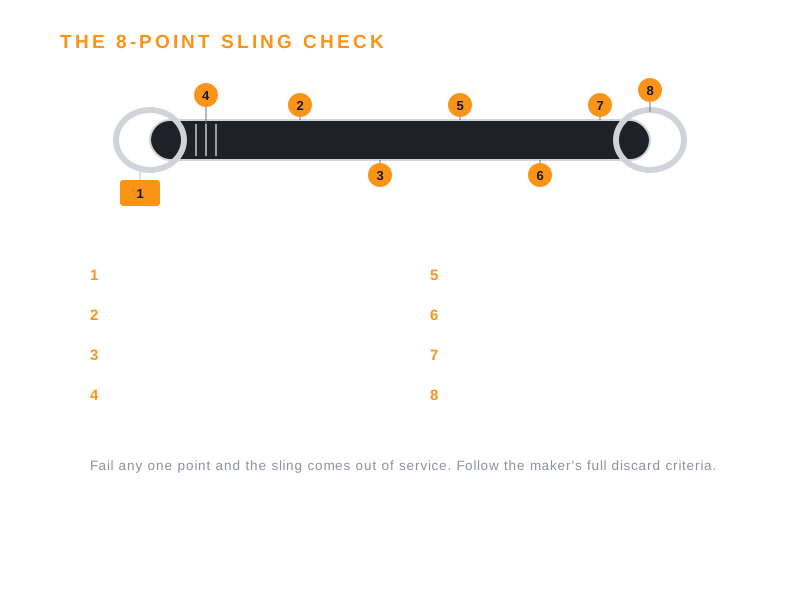
One sling. Eight things to check.
The diagram maps the eight points onto a sling, end to end. The body carries points two through seven - fraying, cuts, stitching, discolouration, kinks and broken wires. The fittings carry corrosion. The tag carries the first point of all.
Work it the same way every time and it becomes muscle memory: tag first, then down one side and back the other, eyes and fittings last. A consistent path is how you stop skipping the spot that matters.
Even a sling that looks fine at a glance can hide a weakened stitch line or a single broken wire. The check is what turns "looks okay" into "is okay".
We make the check part of the record.
The eight-point field check is yours to run before every lift. The formal inspection is ours - a competent person assessing every sling against its discard criteria, recording the result against the serial number, and tagging anything that fails out of service.
That turns a habit into evidence: a documented inspection history an insurer or auditor accepts, and a rigging inventory where every sling on the rack has been read, felt and signed off. We put your slings on that schedule whenever you ask - it is part of our Venue Systems Health Check.
We've got the record. You've got the show.
Want the slings checked and on the record?
Book the team
Know the standard
Book a Systems Health Check.
We inspect every sling against its discard criteria, tag what passes, retire what fails, and hand you a documented history. Australia wide.
Book the checkAS 4991 lifting equipment.
What the lifting-equipment standard asks of slings, shackles and the gear above them - in plain language.
Read the explainer